


Equipment
Gas cylinder handlers
Safe moving, lifting and positioning of heavy gas cylinders with less physical strain on the operator.
From simple transport to precise positioning
Gas cylinders are heavy, tall and relatively narrow, which can make tilting, rolling and lifting them by hand a demanding task. Suitable equipment takes the weight of the cylinder and stabilises it during handling, while the operator controls its movement.
STS gas cylinder handling equipment allows cylinders to be transported safely through the plant and, where needed, lifted, placed on raised surfaces or rotated. Simple transport trolleys, hydraulic lifters, counterbalanced handlers and special versions for LPG and medical cylinders are available. The most powerful standard lifters are intended for cylinders weighing up to 250 kg.
Depending on the process, the cylinder can simply be transported across the floor, lifted from the floor to a higher level, placed on a platform or process equipment and, with special versions, rotated in a controlled way.
Gas cylinder transport trolleys
For moving cylinders at floor level, four-wheeled trolleys are used that transfer the weight of the cylinder to the chassis rather than to the operator's arms and back. Front auxiliary wheels make it easier to pick up the cylinder, while a safety chain keeps it secured during transport. The standard version has a capacity of 150 kg and is intended for cylinders of 190–250 mm in diameter and up to 1,600 mm high.
Gas cylinder lifters
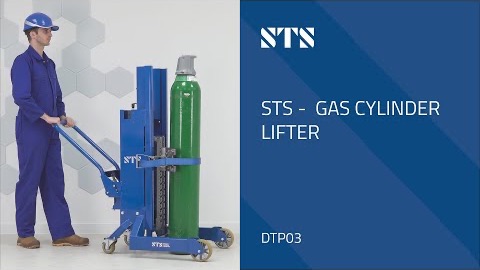
For processes in which the cylinder has to be lifted from the floor, mobile hydraulic lifters are used. The cylinder rests against a rubber-coated contact surface and is secured with an adjustable ratchet strap, after which the operator lifts it hydraulically and moves it to the required position.
The standard version has a capacity of 250 kg, accepts cylinders of approximately 180–450 mm in diameter and has a lifting stroke of 500 mm, or approximately 450 mm of free lifting height.
Lifting and rotating a gas cylinder
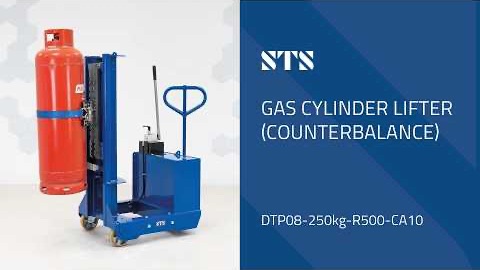
For processes in which the cylinder must also change orientation as well as being lifted, a counterbalanced version with a rotation mechanism is available.
The cylinder is secured with a strap against a rubber-coated contact surface, lifted hydraulically and then rotated sideways in a controlled way by a geared mechanism. When the operator is not turning the handle, the mechanism holds the cylinder mechanically locked in position. The standard capacity is 250 kg, and the gripper is designed for cylinders of 180–550 mm in diameter and 1,200–1,800 mm high.
LPG cylinder trolleys
For larger LPG/propane cylinders there is a special version adapted to the larger container diameter and to work on different surfaces.
The trolley has a capacity of 125 kg and is intended for cylinders of 300–450 mm in diameter and up to 1,500 mm high. The design uses four main wheels, including pneumatic wheels that make movement easier even on rougher outdoor surfaces.
Medical gas cylinders
For hospitals, clinics and other healthcare settings, compact stainless steel trolleys are available that allow cylinders to be transported while holding them safely upright.
The larger version accepts cylinders of 100–200 mm in diameter, 500–1,350 mm high and weighing up to 80 kg, while the smaller one is intended for cylinders of 100–150 mm in diameter, up to 950 mm high and weighing up to 60 kg. The cylinders are secured with quiet neoprene straps, and the frame is made of 304 stainless steel for easier cleaning and disinfection.
Lifting and weighing in one unit
For processes where the weight of the cylinder needs to be monitored, the lifter can be fitted with an integrated weighing system.
The weight is read while the cylinder is on the handler, with no need to take it to a separate floor scale. For this option STS states an accuracy of ±0.1 kg, with zero and tare functions.
Gallery


Videos
Videos open on YouTube.
Related industries


Would you like safer and more efficient load handling?
Tell us what you do today and how, and we will propose something with better ergonomics, higher productivity and a safer place to work.
